Case study · Product · Since 2025
BegynOne connected system for the day, and the goals behind it.
An AI-assisted personal operating system: goals, routines, health, finances and daily planning in one connected app.
- Role
- Founder, product designer, full-stack developer
- Type
- Independent product
- Status
- Live and actively developed
- Platform
- Responsive web app and PWA
01Why Begyn
Life does not happen in separate apps.
Most personal-development tools cover one isolated part of life: tasks, nutrition, sleep, finances or goals. People end up moving between disconnected apps with no view of how daily behaviour relates to longer-term priorities.
I created Begyn to explore a more connected approach. It combines planning, personal tracking and AI guidance in one responsive product, so you can manage the day while keeping the bigger goals in view.
What I own
- Product strategy and prioritisation
- User flows and interaction design
- Responsive UI for desktop and mobile
- React and TypeScript implementation
- Architecture and reusable components
- Supabase data model, auth and persistence
- AI integration and retrieval-augmented generation
- Onboarding and subscription flows
- Deployment, maintenance and iteration
02In the app
Calm on purpose.
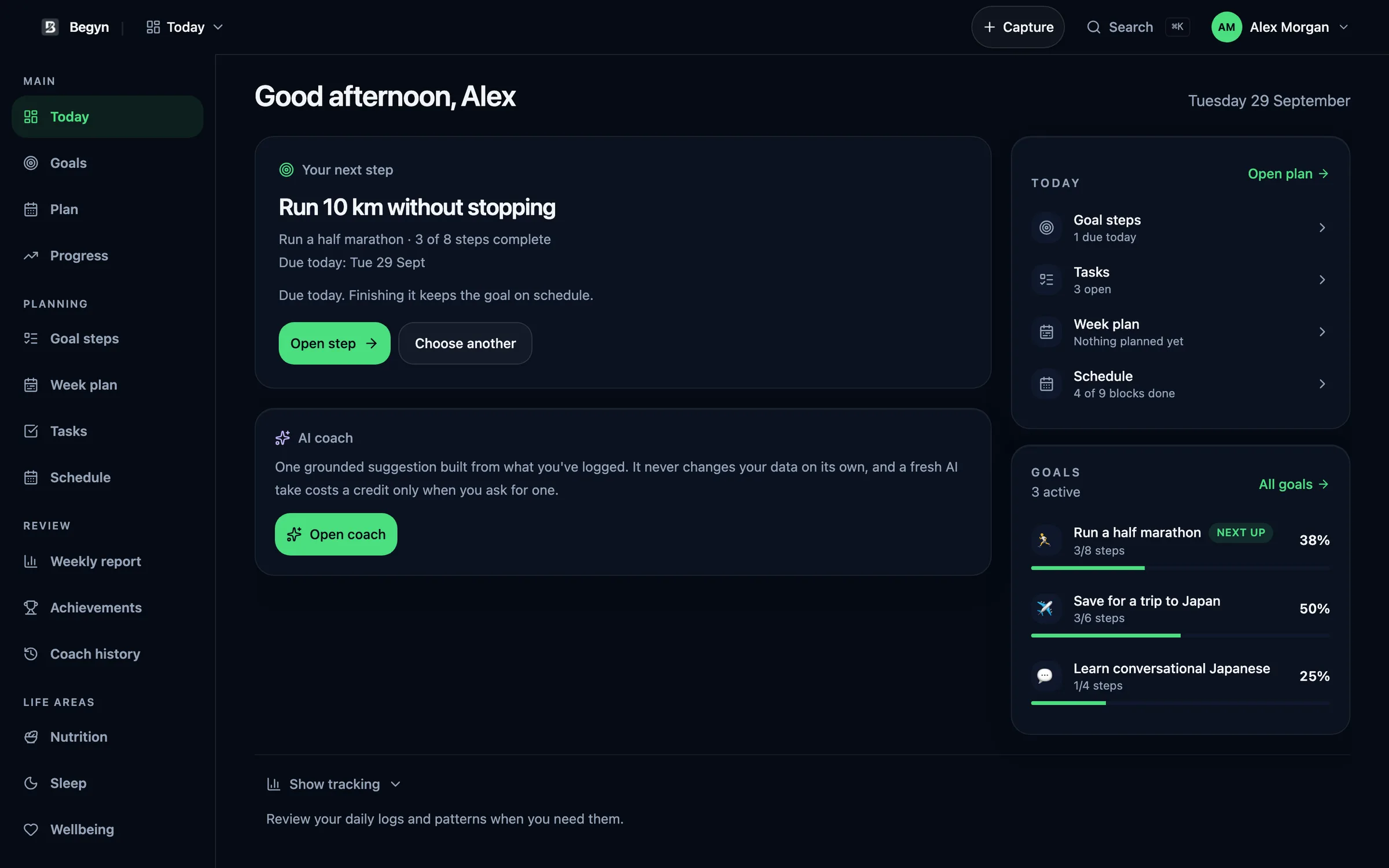
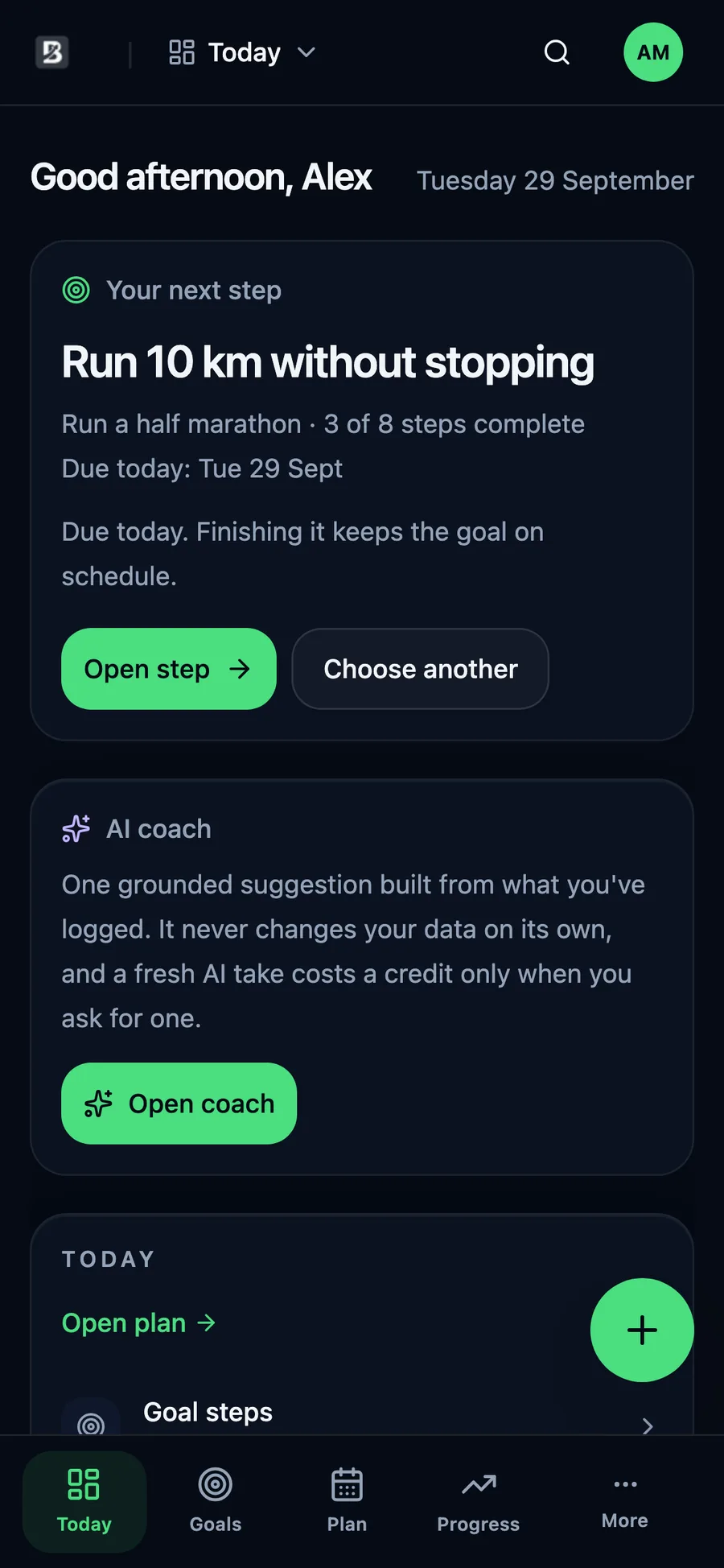
Today. One next step, the coach and the day at a glance.Demo data
03One connected system
Modules that know about each other.
Modules
Each module stands alone. Point at one to see where its data meets the others.
04The AI coach
A coach grounded in your own data, not a generic chatbot.
Try the decision loop
Interactive demo
Next best move · Goals
Run 10 km without stopping
Due today. Finishing it keeps the half-marathon plan on schedule.
One suggestion at a time, with its reasons visible. Nothing changes until you choose.
- Goals
- Sleep
- Finance
- Routines
Illustrative data. In Begyn, feedback like this re-ranks future suggestions.
- 1
Context from every module
Goals, routines, health and finances all feed the coach.
- 2
Retrieve what matters
Embeddings pull the most relevant, durable user context instead of sending everything.
- 3
One grounded next action
The model connects today’s behaviour to longer-term goals and proposes something practical.
- 4
You stay in control
Suggestions can be accepted, snoozed or rejected, and that feedback shapes the next ones.
05Architecture
Four layers, no custom server.
01 Interface
React + TypeScript
Feature modules, built with Vite
TanStack Query
The only server-state layer
Installable PWA
One codebase for desktop and mobile
02 APIs & logic
Edge Functions
Every secret lives server-side
AI coach
Context, retrieval, one next action
AI credits
Idempotent, refunded on failure
03 Data
Postgres
Goals, routines, health, finance
Row-level security
Every row scoped to its owner
Vector memory
Embeddings for the RAG coach
04 Operations
Vercel
Web deploys
Ops events
Privacy-safe failure signals and alerts
External services
Claude
Coach and plan generation
OpenAI
Embeddings for retrieval (RAG)
Stripe
Subscriptions, being finalised
No secret keys in the browser.
How a request flows
- Everyday reads and writes go straight to Postgres, protected by row-level security.
- Anything that needs a secret, such as AI or billing, goes through an Edge Function.
- The coach retrieves relevant memories by embedding, then asks the model for one grounded next action.
React · TypeScript · Vite · TanStack Query · Supabase · Edge Functions · Claude API · OpenAI · Stripe · PWA
06Product decisions
Five decisions that shaped it.
01
One connected system, not separate trackers
The value is in the relationships. A financial goal changes daily priorities, sleep affects performance, and a long-term goal should turn into visible next actions.
The trade-off
The risk is an overwhelming interface, so the dashboard and each module show the most relevant information first and reveal detail on request.
02
A Progressive Web App, not separate native apps
One maintainable product across desktop and mobile let me iterate quickly while still feeling like an app.
The trade-off
Responsive here does not mean a shrunken desktop. Large screens use space with purpose; phones get clearer priorities, tighter navigation and less density.
03
Contextual AI, not a generic chatbot
Retrieval-augmented generation grounds the coach in the user’s own Begyn data.
The trade-off
The AI is there to spot patterns, connect daily behaviour to goals and suggest a practical next step. That meant deciding which context is useful, how much to retrieve and how to keep answers focused.
04
Modules that can evolve independently
Begyn covers many areas of life, so the app is built from distinct modules that change without coupling the whole interface.
The trade-off
Shared concepts such as dates, progress, goals, routines and preferences still behave consistently, which shaped the reusable components and data patterns.
05
Guidance without taking control
Begyn helps people decide what to do next without deciding for them. Suggestions, progress and prioritisation support judgement rather than replace it.
The trade-off
Automation is paired with explicit control, especially when a suggestion touches goals, schedules or personal information.
07Challenges
The hard parts were not the features.
Breadth versus clarity
Bringing life together is Begyn’s strength and its central UX problem. Adding features is easy; keeping the product calm is hard. It pushed me towards hierarchy, progressive disclosure, onboarding and the next action over every metric at once.
Genuinely different screen sizes
Layouts balanced on a phone felt sparse on a large display, and desktop density felt cramped on mobile. I now treat them as related but distinct experiences, with their own composition, navigation and density.
Making AI useful inside a real product
Calling a model is the easy part. Choosing context, grounding answers in user data and adding more than a chat window is the real work. It taught me to treat AI as a product capability with retrieval, interface and trust considerations.
08What I learned
In my own words.
Product judgement
“More functionality does not automatically mean more value. The harder decision is often what to hide, postpone or simplify so the user always knows what matters next.”
Full-stack ownership
“Owning the whole product changed how I make engineering decisions. A database choice affects the interface, an onboarding decision affects retention, and a small UX change can ripple through the application.”
AI product development
“Useful AI depends less on a chat window and more on the right context, clear boundaries and output that fits a workflow where the user stays in control.”
Responsive design
“Responsive design is not the same interface at different widths. Desktop and mobile users have different attention, space and context, so each layout needs deliberate priorities.”
Iteration
“The first implementation is a hypothesis. Shipping shows where the product is confusing, rigid or needlessly complex, and then I can improve it with better information.”
Founder perspective
“Building an independent product made every trade-off mine: what to build, how it works, how it looks and whether the technical cost is worth the value for the user.”
09Where it stands
Live, and still improving.
Begyn is a functioning production application with its central modules, onboarding and RAG-based AI coach in place. I keep improving its responsive experience, product hierarchy, AI capabilities and path to a sustainable subscription product.
Implemented
- Dashboard and core life modules
- Goals with actionable next steps
- Profiles and onboarding
- RAG-based AI coach
- Subscription flows, built and tested
- Installable PWA
Next
- Responsive experience across screen sizes
- Product hierarchy and progressive disclosure
- Deeper AI capabilities
- Commercial payment setup, being finalised